


Article by Simón Rios
January 21, 2026 from WBUR News. Accessed 01.26.2026.
With thousands of Haitians in Massachusetts set to lose legal status on Feb. 3, more than a dozen labor leaders, health care officials, clergy and community organizers testified before a congressional “field hearing” in the heart of Boston’s Haitian community Tuesday.
The message at the Mattapan meeting: Requiring Haitians to return to a country overrun by gangs could have deadly consequences — and losing Haitian workers will hurt the Massachusetts economy, affecting health care, air travel and other industries.
“These are not jobs that can easily be filled,” said Colin O’Leary, who runs Laurel Ridge Rehabilitation and Skilled Care Center in Jamaica Plain. He said his facility is about to lose 40% of its dietary aides, as well as 15% of certified nursing assistants, a group he said are the “backbone of our industry.”
“These jobs require a personal relationship between the staff and the residents that are forged over months and years together,” O’Leary said.
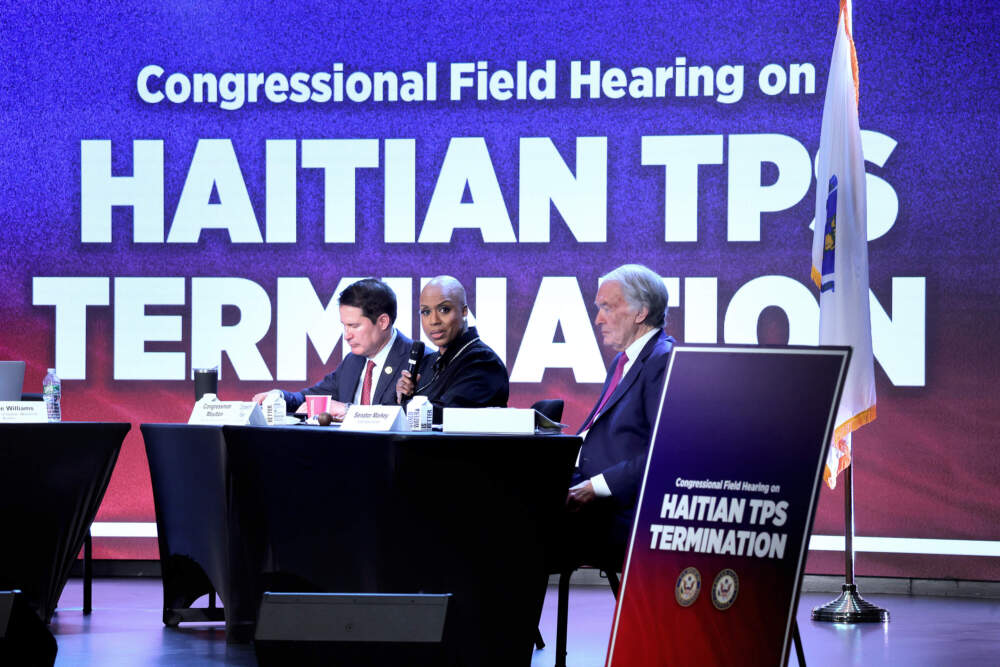
Rep. Ayanna Pressley presided over the hearing, joined by Sen. Ed Markey and Rep. Seth Moulton, who’s challenging Markey for his seat. Pressley excoriated the Trump administration for upending Temporary Protected Status for Haitians. Across the U.S., more than 330,000 Haitians hold TPS, according to the Congressional Research Bureau.
“ Quite simply, there is no safe return to Haiti right now,” Pressley said, adding, “TPS holders are living with fear and uncertainty — parents, workers, caregivers, faith leaders who are deeply rooted in our communities and essential to our economy.”
Support WBUR
The loss of TPS for Haitians is already affecting operations at Logan Airport, said Kevin Brown, executive vice president of 32BJ of the Service Employees International Union. Brown said the union represents about 2,000 workers at Logan, and more than 100 Haitian TPS holders among them have already lost their jobs.
Brown said that’s because some companies may be terminating workers ahead of the expiration of TPS, and that officials are canceling permissions that allow people to work in certain areas of the airport.
Temporary Protected Status has been granted to roughly 1.3 million people from 17 countries, and Massachusetts is home to an estimated 45,000 of them, according to the Congressional Research Service. The exact number of Haitians with TPS in the state is unclear. Attorney General Andrea Campbell cited 15,000 last year, though that could be a significant undercount.
A spokesperson for U.S. Citizenship and Immigration Services said the data is not readily available.
TPS was originally granted to Haitians after a catastrophic earthquake in 2010. Homeland Security Secretary Kristi Noem ended the program last year, arguing conditions in Haiti no longer justified granting Haitians legal status.
But at Pressley’s hearing at Jubilee Christian Church in Mattapan Tuesday, speaker after speaker said the decision to end TPS was more motivated by racism than by conditions on the ground in Haiti, which continues to be plagued by gang violence and extreme poverty.
“ I just can’t understand how anybody can function under that, and I can’t understand how anybody could send people to be faced with those conditions,” said Brian Concannon of the Marshfield-based Institute for Justice and Democracy in Haiti.
Some 1.4 million people have been displaced within Haiti, Concannon said, explaining that’s roughly equal to the combined populations of Boston, Worcester, Springfield, Cambridge, Lowell, Brockton and New Bedford.
Denise Williams, of the Association of Haitian Women of Boston, said Haitians make a large contribution to the U.S.
Support WBUR
“This administration would like you to think that they just come here and are eating up all our resources — this is a falsehood. They’ve come here with the intention of working and contributing,” she said to applause from the room.
A 60-year old Brockton resident with TPS status also spoke at the hearing. He introduced himself by his last name, Bruno. He said his wife and two sons also have TPS, and they’ve been unable to secure permanent legal status in the U.S.
After the hearing, Bruno told WBUR it’s too dangerous to return to Haiti when his status expires, and he’s yet to decide his next moves.
“I don’t know, I don’t know,” he said. “Because I have mortgage, I have car loan … and my children in college.”
Bruno said he came to the U.S. after the 2010 earthquake and drove a school bus, eventually landing a job as a city bus driver. He said he won’t be able to drive a commercial vehicle once his status ends — as his CDL license and work authorization expire.
As for many Haitians in his situation, that could mean staying in the U.S., and hoping his family isn’t targeted by ICE.
Despite the looming deadline, there may be hope in the short term for TPS recipients from Haiti. Multiple ongoing lawsuits are challenging the legality of how the administration terminated the program.
One of the suits is before a federal judge in D.C., and could see a decision ahead of the Feb. 3 deadline.
Andrew Tauber, who’s representing Haitians in that case, told WBUR he’s awaiting a ruling that could extend Haiti’s TPS designation for another six months. But even if they win, Tauber said in an email, “nothing would prevent the administration from trying to terminate Haiti’s TPS designation on a lawful basis.”